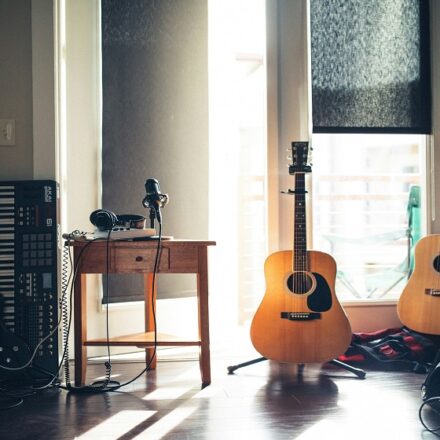

Remember the panic of 2023? We were all staring at the first wave of generative AI, convinced that “Ghost in the Machine” was about to become a literal description of the Billboard Hot 100. We thought the end was coming for guitarists, vocalists, and especially producers.
Table Of Content
We were wrong. But we weren’t right, either.
Three years later, the music studio looks nothing like it did in the early 2020s. The 48-channel SSL desk is still there (mostly as a $200,000 piece of industrial art), but the workflow has fundamentally fractured. As of 2026, we aren’t just using AI to make music anymore. We are co-producing with it. And the results are stranger, faster, and more human than anyone predicted.
Here is how AI has actually changed the game in the last three years.
1. The End of “Writer’s Block” (and the Start of “Idea Overload”)
In 2026, nobody starts a session with a blank DAW. You start with a “Stem.”
Tools like Ableton 13 and Logic Pro AI now ship with predictive arrangement engines. You hum a melody into your phone? Within ten seconds, the AI generates a 4-bar loop. Within sixty seconds, it suggests a full arrangement: verse, chorus, bridge, and even an “outro with a key change” if you’re feeling dramatic.
The problem isn’t writing anymore. It’s editing. We now have a new job title in the studio: the AI Prompt Engineer. Instead of tweaking compressors, we’re typing things like: “Make this chorus heavier, but remove the snare reverb, and give the bass a ‘90s grunge distortion.”
It’s magic. It’s also exhausting. The hardest skill in 2026 is knowing when to stop generating and start listening.
2. The Vocal Deepfake That Saves Lives
The vocal booth is finally optional.
We have moved past the robotic “T-Pain effect.” Today’s AI vocal modeling (pioneered by Respeecher Studio and Vocaloid 6.5) allows a pop star to sing in a whisper and have the AI render it as a full-chested belt. But the ethical evolution is the real story.
In 2026, we have “legacy models.” With proper estate approval, you can legally license the timbre of a 1980s icon to sing a harmony on your indie track. More importantly, for living artists, “voice preservation” is standard.
When a pop star loses their voice mid-tour due to nodules, they don’t cancel the show. They run the live mic through a real-time AI model that replaces the strained frequencies with the way the singer sounded five years ago. It’s uncanny. It’s controversial. But it’s ubiquitous.
3. The “Mic Drop” Mix (Literally)
The $10,000 mastering engineer isn’t extinct, but the $10 intern is.
Automated mixing has finally crossed the uncanny valley. In 2026, you don’t “send stems” to a service; you stream your session to an AI that listens like a producer.
Neural Mix Engine can now identify ear fatigue. If you’ve been working on a track for four hours, the AI will automatically suggest: *“Your high-end is too aggressive. I’ve pulled down 8kHz by 1.5dB. Also, that reverb on the snare is clashing with the vocal. Turn it off?”*
It’s not just an algorithm; it’s a second pair of ears. The result? A bedroom producer in Iowa can now achieve a mix that slams as hard as a Mike Dean master. The barrier to entry for sonic quality is zero.
4. The Legal Quagmire: The “Style Shift” Loophole
We cannot talk about 2026 without addressing the elephant in the server room: The Taylor Swift vs. Suno ruling of 2025.
The courts decided that you cannot copyright a style. You can only copyright a recording. Therefore, while you can’t press “Generate a new Taylor Swift song,” you can press “Generate a new song in the style of a 24-year-old female confessional singer-songwriter with a Nashville bent.”
This has led to the rise of “Parallel Pop.” Major labels now release “Official Style Packs” for AI generators. You pay $9.99, you get the “Ariana Grande Harmonies Pack.” It doesn’t sound exactly like her (to avoid lawsuits), but it sounds close enough for 90% of listeners. The ghost note is that the real Ariana benefits from the licensing.
5. The Unexpected Renaissance of Lo-Fi
Here is the irony of 2026: Precisely because AI can make anything perfect, “flaws” have become luxury goods.
Cracked vinyl samples, slightly out-of-tune pianos, the sound of fingers squeaking on guitar strings—these “artifacts” are now the most valuable commodities. We have seen a resurgence of tape machines and analog synths, not because they sound better, but because AI can’t perfectly replicate a random voltage spike from a storm in 1978.
Producers are now “dirtifying” their AI-generated tracks. There are plugins that insert realistic “mistakes” (a cough in the control room, a spilled coffee on the console) to prove a track was made by humans.
The Verdict: Who is the Artist?
As I sit in my studio in 2026, I have a synth drone playing that I didn’t write, a drum pattern that the computer suggested, and a vocal that was pitch-corrected by a neural network. Who gets the Grammy?
We have decided it doesn’t matter. AI hasn’t replaced the artist; it has replaced the drudgery. We still need the taste. The sadness. The joy. AI can give you a thousand options for the “sad chord progression,” but it can’t tell you which one makes you cry.
The future of music isn’t robot pop. It’s cyborg pop. And for the first time in a decade, the dance floor is packed.
What’s your take? Are you using AI in your studio yet, or are you holding onto the last pure analog signal chain? Drop a comment below.